Preparing QuickBooks for an adaptive, data-driven future
Intuit • 2023
Tasks
Research
Strategy
Design leadership
Usability testing
Role
Principal Designer

Mockups of the QuickBooks onboarding flow to show AI and personalization could be used to make understanding the product in the first 30 days much easier.
Project Goal
QuickBooks aimed to support both startups and large enterprises across various industries by offering a more personalized, adaptive accounting experience. My role was to establish key design principles and frameworks to guide multiple teams in integrating AI seamlessly into the user journey.
Challenge
We found new users were dropping off early. Our research indicated two core issues:
We were asking for too much information upfront.
The onboarding experience didn’t adapt meaningfully to different business types or experience levels.
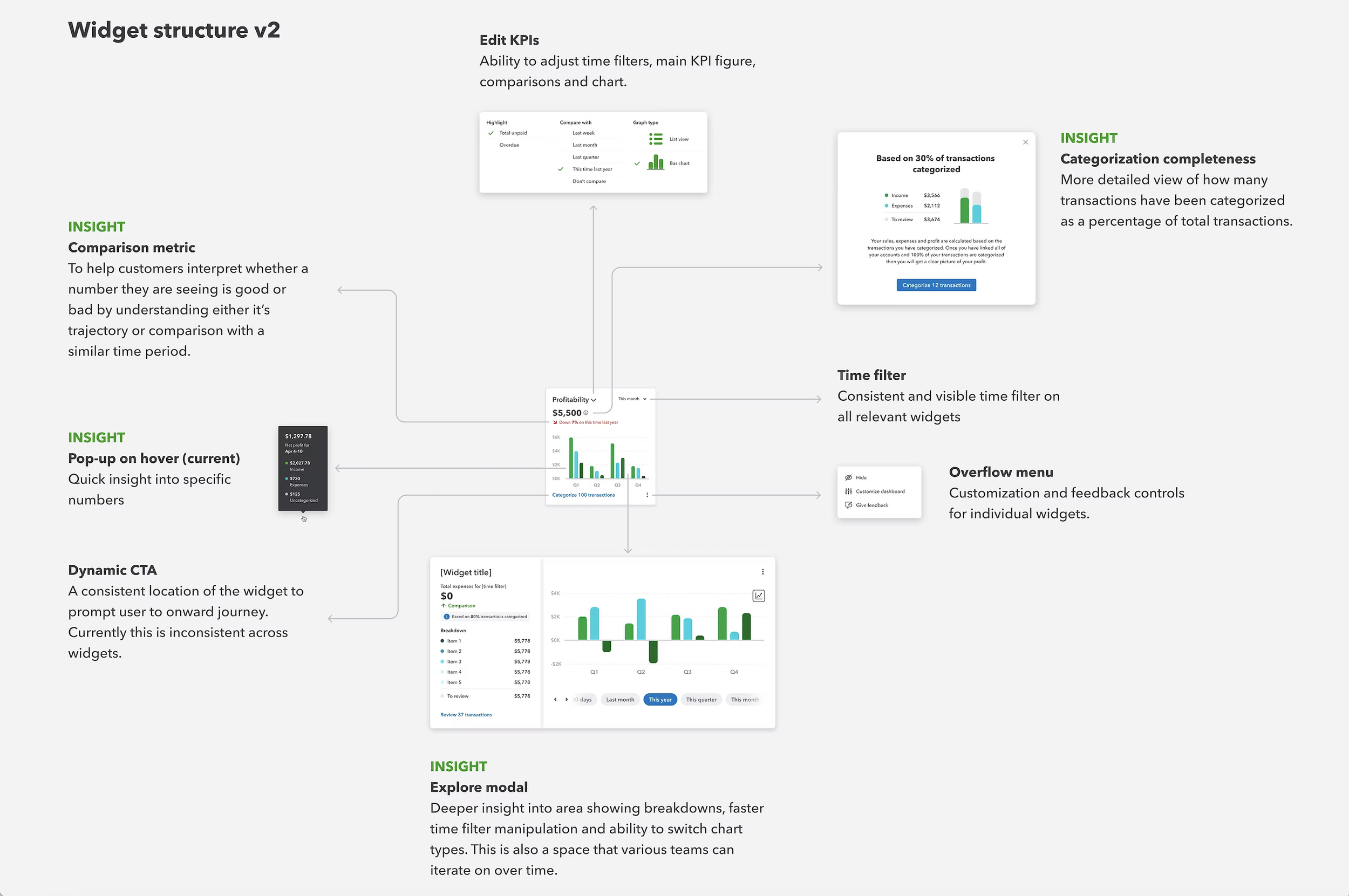
We had to consider the architecture of widgets on the analytics page to ensure that we could implement personalization in a scalable and consistent way.
Approach
Collaborating closely with a technical director, there were three main approaches we took to this work:
Defining a data-aware onboarding strategy
We mapped out data we legally needed to capture as well as what we could technically capture both pre and post authentication. This helped us simplify onboarding to capture the essential data and gave us a structure model we could use to drive persinalisaton downstream.
Desiging a Personalization Framework
Because personalization spanned multiple squads, I operated horizontally across the organization. I created interactive wireframes to show how data capture in one part of the journey could impact experiences elsewhere. This helped to guide the team without fragmenting the overall experience
Prototyping contextual support experiments
Finally, we ran small proof-of-concept tests, partnering with the YouTube content team to understand how help content videos are structured and tagged. This allowed us to explore how we could surface help contextually based on our key data parameters.
Outcomes
Reduced friction in onboarding by limiting required inputs to essential data
Created a scalable parameter framework for AI-driven adaptation
Improved cross-team alignment around personalization strategy
Established foundational patterns for context-aware support during the first 31 days of product use

Design principles we created using the broad body of Intuit research used to guide personalization project teams.